
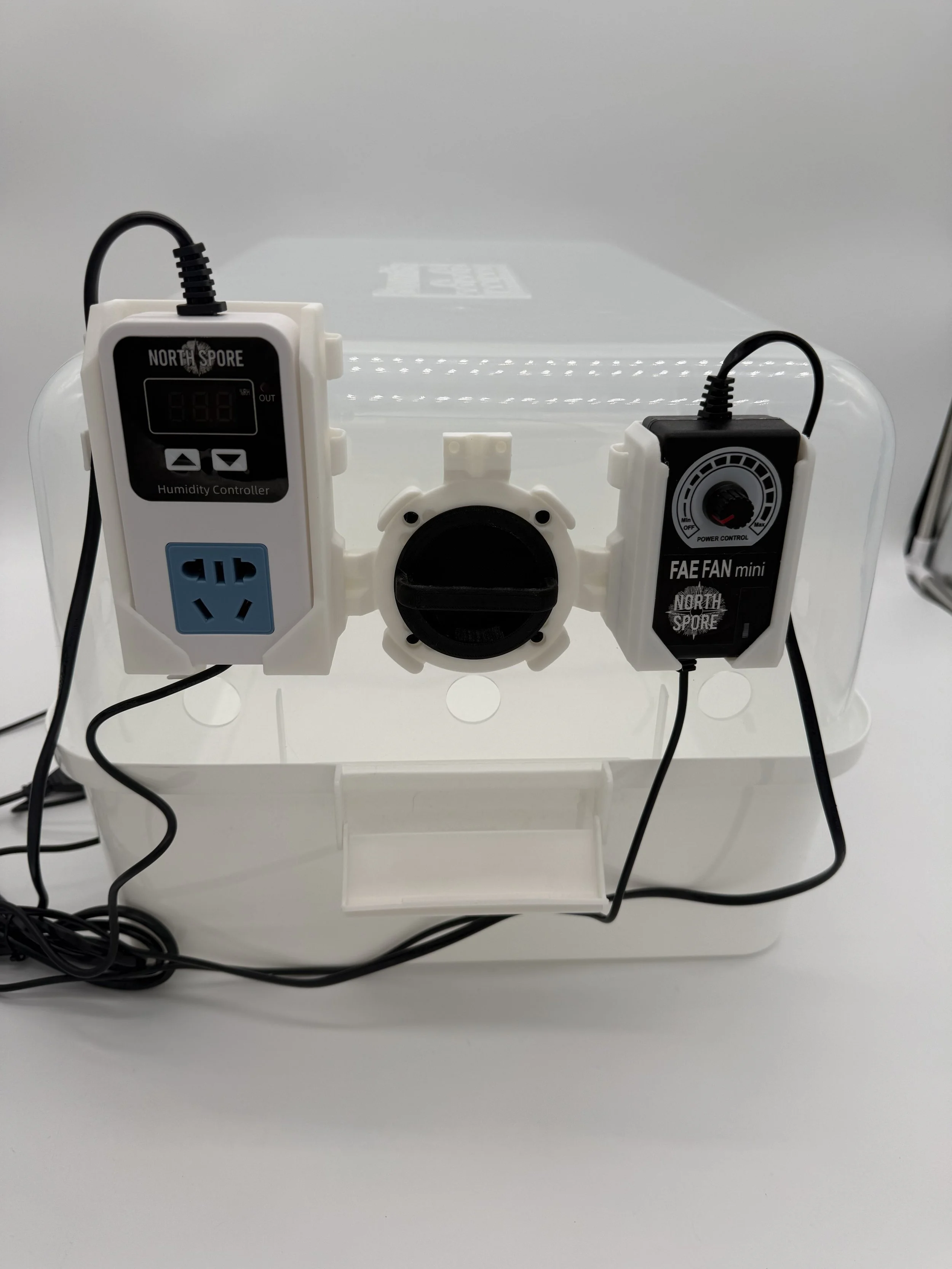
If you saw the short video I recently posted showing my modular sensor setup for the North Spore Boomr Bin, I want to make one thing clear right away: this is still very much a prototype.
There is a lot of work left to do before I release it.
What I showed in the video is really just a glimpse at where the project is heading. There are parts that need to be redesigned, connectors that need more work, modules I haven't shown yet, and a lot of little details I want to get right.
But this project is also turning into something bigger than just a sensor mount for the Boomr Bin.
The Idea Behind the System
The goal is to create a common modular system for mounting sensors, controllers, cable management, and other accessories around my mushroom growing equipment.
Instead of designing a completely different mounting solution every time I want to support another sensor, I want to have a standardized connection that I can build around.
The center piece becomes the foundation, and individual modules can be designed for whatever needs to attach to it.
That might be a temperature and humidity sensor, a CO₂ sensor, a controller, cable management, or something I haven't thought of yet.
The important part is that I don't have to reinvent the entire system every time I add something.
Rethinking the Connector
The connection between those pieces has probably been one of the most important parts to figure out.
My original approach was to have a separate male connector that screwed onto whatever module I wanted to use.
As I started actually building the system, I realized I didn't really like that approach.
I also experimented with having the male connection as part of the module itself. After working with it more, I ended up reversing that arrangement.
The current direction has the male connector on the center piece and the female connector built into the interchangeable module.
That makes a lot more sense for what I'm trying to build. The center provides a consistent connection point while each accessory can be designed around the same female interface.
Neither side is completely finished, though. The male connector still needs work, and I'm continuing to refine the female side as I design more modules.
I Tried Making It More Complicated
I've also considered more sophisticated ways of locking and releasing the modules.
One idea I really liked was some kind of push-button release. Press the button, unlock the module, and pull it off.
It's a cool idea, but I kept running into the same problem: strength.
Adding moving pieces and locking mechanisms to a relatively small 3D printed connector introduces more places for it to flex or fail. For something that I want to become the foundation of an entire modular system, I would rather have a simple connection that I trust than a fancy one that isn't as strong.
I may revisit a push-button system in the future. For now, I'm concentrating on getting the basic connector right first.
There Are Already More Modules
The prototype shown in my video isn't everything I've designed.
There are two additional modules that I didn't show because they failed to print successfully.
The failures weren't necessarily some dramatic failure of the modular concept. Sometimes 3D printing is just 3D printing. In this case, I had supports fail during the prints.
Those modules will come back once I've made some changes and successfully printed them.
That's also why I don't want to rush this project out. A CAD model working on my screen doesn't mean I consider the design finished.
This Already Works With the Boom Room II
One thing I want to clarify is that I don't need to redesign this entire system when I move it over to the Boom Room II.
That's actually one of the biggest benefits of doing all this work now.
The modular pieces and connector system I'm developing for the Boomr Bin translate directly to my Boom Room II. Most of the additional work should simply be creating the appropriate hook-style attachments for mounting the system to the Boom Room II.
The core system stays the same.
That's exactly what I want from a modular design.
Instead of having a "Boomr Bin sensor system" and then designing a completely separate "Boom Room II sensor system," I can change how the system attaches to the grow equipment while keeping the same modules and connections.
That means a sensor module I design today shouldn't need to be redesigned just because I decide to move it from a Boomr Bin to a Boom Room II.
It's Also Making Me Revisit My Older Designs
An unexpected side effect of this project is that it has made me look at a lot of my previous designs differently.
Some of my older mounts were designed to solve one very specific problem. They worked, but at the time I wasn't necessarily thinking about how that part would relate to everything I might design later.
Now I am.
As I've been developing this modular system, I've started going back through some of those older designs and rebuilding or improving them with what I've learned since making them.
Some can become modular. Some can be simplified. Some can have better cable management. Others just need to be redesigned because I know how to make them better now.
I don't see that as the old designs being bad. It's just a pretty visible record of how my approach to 3D design has changed.
Developing a Design Language
That's also leading me into something I haven't paid enough attention to before: design language.
I want the things I make to start looking like they belong together.
That doesn't mean every part needs to look identical, but there should be some consistency between them. Similar shapes, connection methods, proportions, hardware choices, cable management, and other small details can make separate designs feel like parts of the same system.
I'm still figuring out what that design language should be.
This modular project is forcing me to think about it because I can't just design every module in isolation. When you start putting several pieces next to each other, inconsistencies become much more obvious.
It's another part of the project that I expect will evolve over time.
Expanding Beyond North Spore
Eventually, I would also like to adapt this system to equipment from other brands.
That's where mounting becomes a much bigger challenge.
The Boomr Bin already gives me screw holes that I can take advantage of. Another monotub may not.
Ideally, I'd like to find ways to attach the system without requiring permanent modifications. That could mean clamps, clips, brackets, friction-fit adapters, or other mounting methods depending on the equipment.
If there isn't a good non-destructive way to mount it, I may eventually have to offer designs that require drilling holes.
I'd prefer to avoid that whenever possible, but I'm also not going to create a complicated or unreliable mounting system just for the sake of saying no modification is required.
The important part is that the mounting adapter can change without changing the modular system itself.
If I can get that right, supporting another grow setup becomes a matter of figuring out how to attach the existing system to it rather than starting over.
A Lot Left to Figure Out
There's no release date for this yet.
The connector needs more refinement. I have modules that still need successful prototypes. Cable management needs work. I want to support more sensors. I'm rebuilding some of my previous designs around what I've learned, and I'm still working out what I want my overall design language to look like.
But that's also why I'm enjoying this project so much.
I'm not just designing another sensor mount anymore.
I'm trying to build a common foundation that I can keep designing around, whether it's attached to a Boomr Bin, hanging from my Boom Room II, or eventually adapted to something made by another company.
The prototype in the video is just the first look at that idea.
There will probably be plenty more failed supports before it's finished.
